Matsubokkuri
Matsubokkuri - Storm Glass+ Lapis Lazuli | Glass Pen
Matsubokkuri - Storm Glass+ Lapis Lazuli | Glass Pen
🔒 Secure payment · 📦 30-day return (unopened items) · ✉️ Questions? hi@shosai.ca
Couldn't load pickup availability
Every other stone in the Storm Glass+ line lets some light through — ruby glows, quartz nearly disappears, amethyst shifts from deep violet to clear. Lapis lazuli does none of that. It's the one variant where the stone stays fully opaque no matter how the light hits it, so instead of glowing from within, the blue just sits there, solid and matte against the storm glass crystals drifting around it. In Japanese the stone is called 瑠璃 (ruri), and the color it's named for — a deep, slightly uneven blue, sometimes streaked with grey — is meant to recall night sky rather than daylight.
An Old Stone in a New Instrument
Lapis lazuli has been ground into pigment and carved into ornament for thousands of years, prized specifically for a blue that doesn't come from any other common mineral. The fragments sealed in this pen aren't uniform — some lean toward pure ultramarine, others carry grey or near-black mottling where the mineral formed less purely — so the color inside the shaft reads less like a single hue than a cluster of related blues.
The Pen Itself
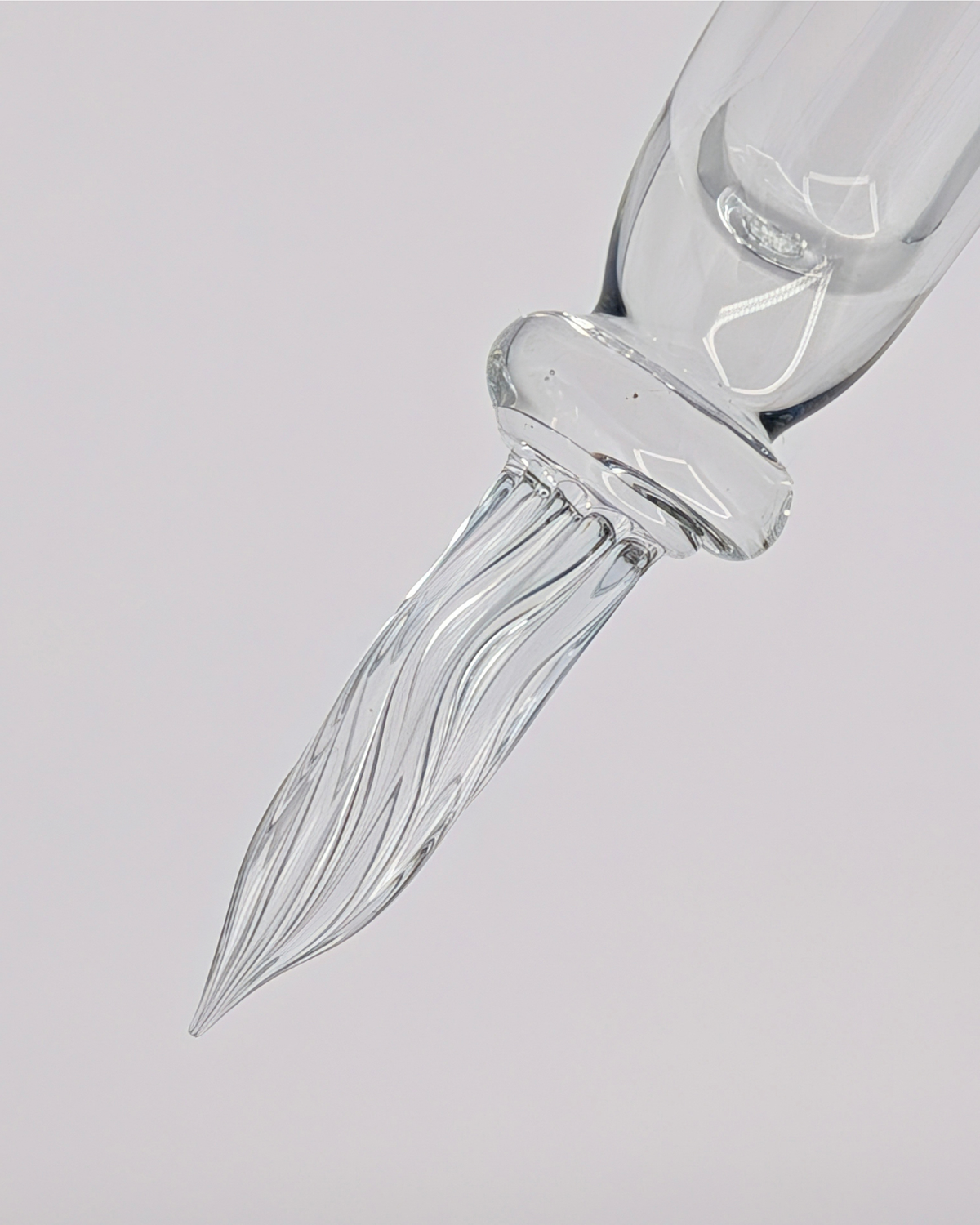
Every Storm Glass+ pen is shaped freehand over an oxygen torch by Kiyoshi Matsumura at Glass Studio Matsubokkuri in Suginami, Tokyo. The shaft is hollow rather than solid, keeping the pen light in hand, with a collar at the base of the nib to stop it rolling off the desk between lines.
Specifications
- Total length: approx. 175mm
- Shaft diameter: approx. 12mm
- Weight: approx. 21g
- Contents (non-toxic): water, ethanol, natural camphor, ammonium chloride, potassium nitrate, natural lapis lazuli
- Nib width: Fine (F), Medium (M), or Broad (B)
- Handmade in Japan
Using and Caring for a Storm Glass Pen
Dip the nib fully before writing — the spiral-cut grooves hold enough ink for several lines per dip. Lapis lazuli sits at around 5 to 5.5 on the Mohs hardness scale, softer than the quartz or ruby used elsewhere in the line, though sealed inside the glass it sees no contact that would wear on it. Rinse under lukewarm water after use and avoid sudden temperature swings, which stress the glass shaft itself.
Frequently Asked Questions
Why doesn't the stone let light through like the others?
Lapis lazuli is naturally opaque, unlike quartz, amethyst, or ruby, which all transmit some light. It's a property of the mineral itself, not a processing difference, which is why this pen looks solid blue rather than glowing.
Will every pen have the same shade of blue?
Not exactly. Natural lapis lazuli varies from deep ultramarine to grey-mottled blue depending on where it formed, so the fragments inside each pen carry their own mix of shading.
Bilingual service — English and French.
Share