Matsubokkuri
Matsubokkuri - Storm Glass+ Rose Quartz | Glass Pen
Matsubokkuri - Storm Glass+ Rose Quartz | Glass Pen
🔒 Secure payment · 📦 30-day return (unopened items) · ✉️ Questions? hi@shosai.ca
Couldn't load pickup availability
This is the quietest stone in the Storm Glass+ line. Where lapis lazuli holds a flat, opaque blue and ruby runs deep red, the rose quartz sealed in this shaft barely asserts a colour at all — a faint blush that shows up more as a softening of the light passing through than as pink in any definite sense. Tilt the pen and the tumbled pieces catch the light smoothly, worn round rather than left sharp-edged the way raw amethyst or crushed ruby are elsewhere in the series.
A Colour That's Mostly Suggestion
Rose quartz gets its tint from trace titanium or microscopic mineral fibres scattered through otherwise clear quartz, and the tint is rarely strong enough to read as a solid colour — it's closer to clear glass with a memory of pink in it. That faintness means this pen changes more with its surroundings than the bolder stones do: against white paper the blush reads clearly, but held up to window light it can look almost as clear as the crystal version.
The Pen Itself
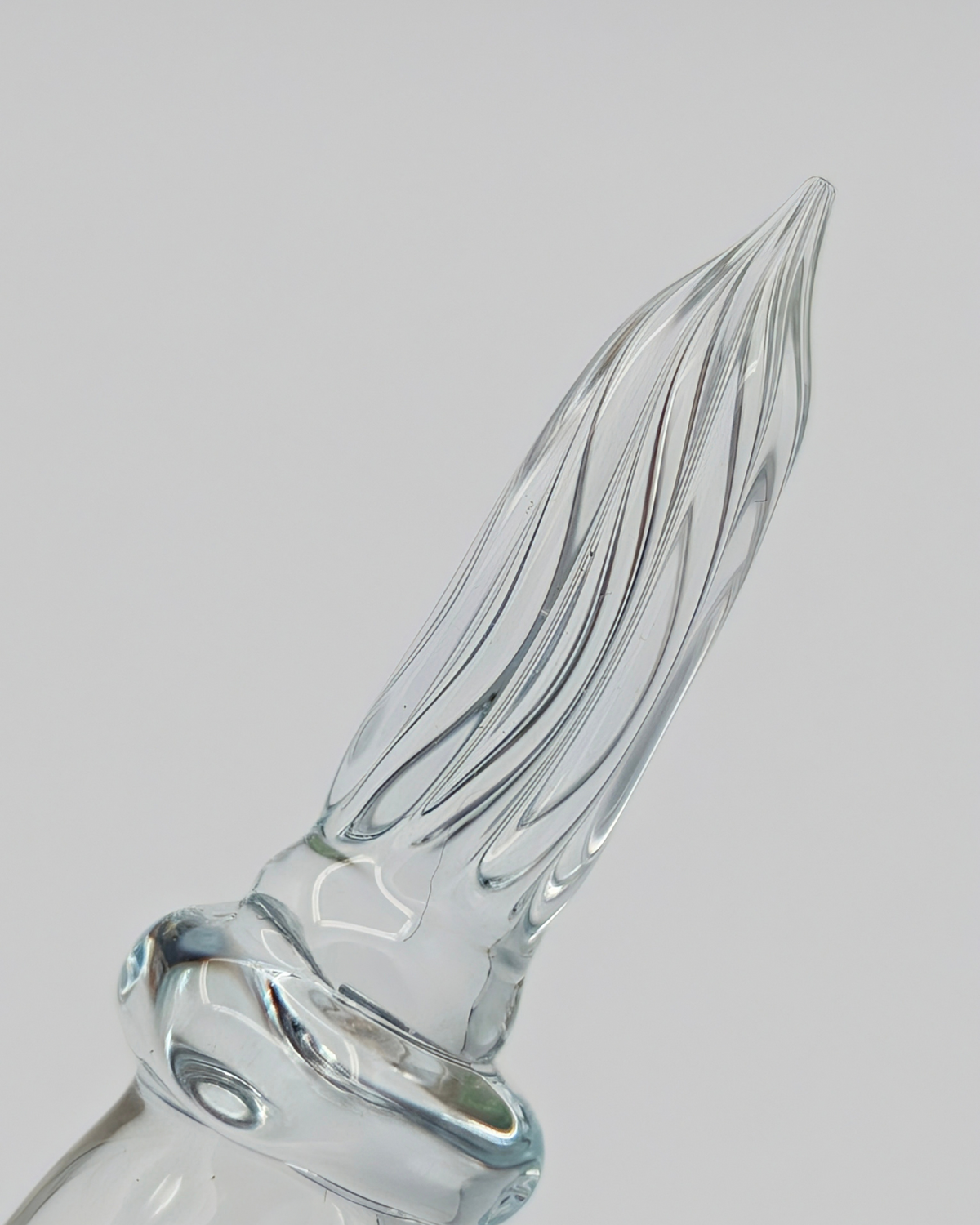
Every Storm Glass+ pen is shaped freehand over an oxygen torch by Kiyoshi Matsumura at Glass Studio Matsubokkuri in Suginami, Tokyo. The shaft is hollow rather than solid, keeping the pen light in hand, with a collar at the base of the nib to stop it rolling off the desk between lines.
Specifications
- Total length: approx. 175mm
- Shaft diameter: approx. 12mm
- Weight: approx. 21g
- Contents (non-toxic): water, ethanol, natural camphor, ammonium chloride, potassium nitrate, natural rose quartz
- Nib width: Fine (F), Medium (M), or Broad (B)
- Handmade in Japan
Using and Caring for a Storm Glass Pen
Dip the nib fully before writing — the spiral-cut grooves hold enough ink for several lines per dip. Like the crystal version, rose quartz sits at a 7 on the Mohs hardness scale, but because these pieces are tumbled smooth rather than left as raw points, they move almost silently inside the shaft instead of catching against the glass. Rinse under lukewarm water after use and avoid sudden temperature swings, which can stress the glass itself.
Frequently Asked Questions
Why does the colour look different depending on the light?
Rose quartz carries very little pigment compared to stones like ruby or lapis lazuli, so its colour is more sensitive to backlighting — it can look pink against paper and nearly clear held up to a window.
Is this the same quartz as the Crystal version, just coloured?
Essentially yes — both are quartz, and rose quartz simply carries trace minerals the clear version lacks. The two are often chosen as a pair for exactly that resemblance.
Bilingual service — English and French.
Share