Shosai
Matsubokkuri - Storm Glass+ Ruby | Glass Pen
Matsubokkuri - Storm Glass+ Ruby | Glass Pen
Couldn't load pickup availability
Matsubokkuri Storm Glass+ Ruby Glass Pen
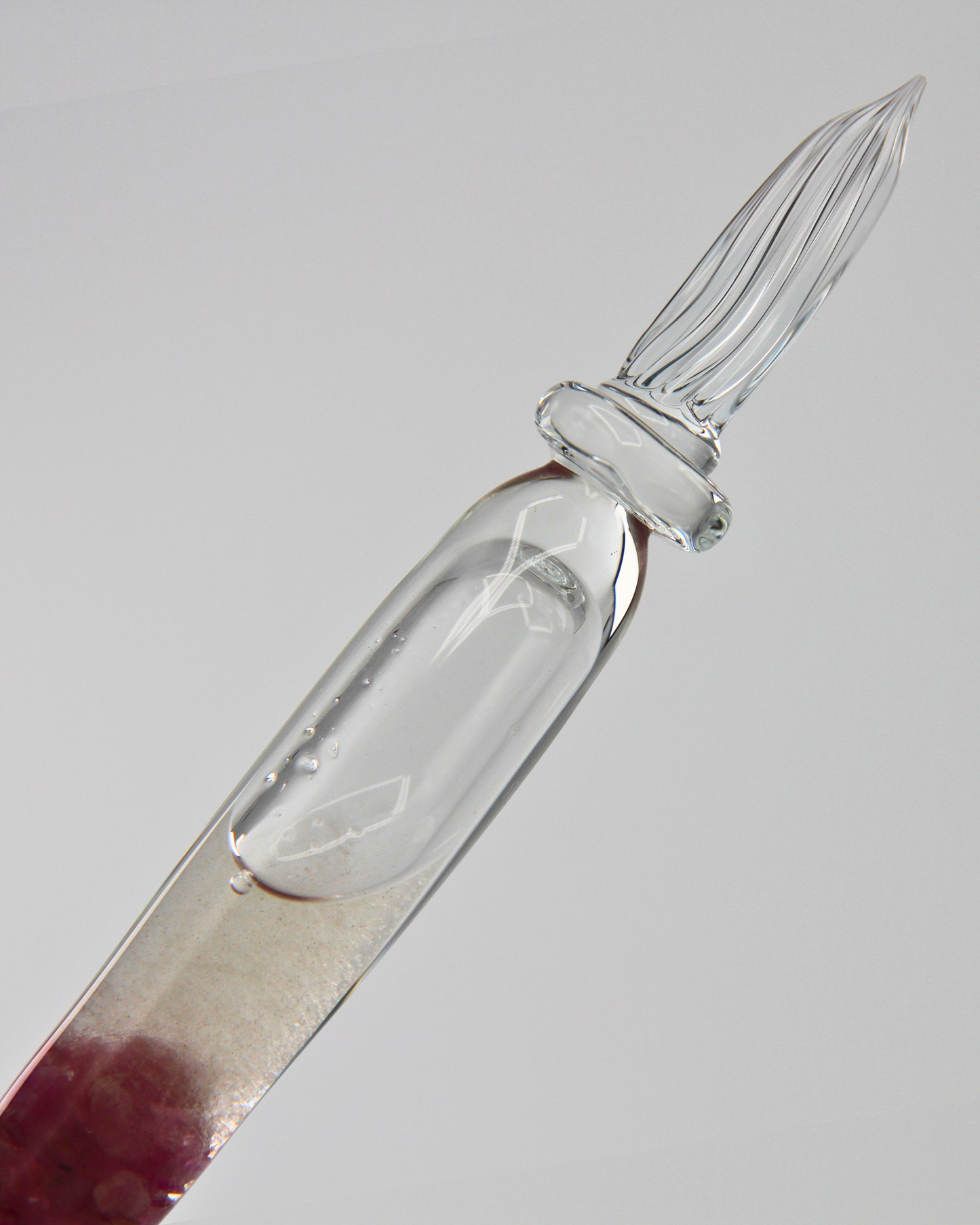
The stone inside this pen isn't cut or polished — it's raw ruby, still carrying the whitish, sometimes faintly green traces of the marble it grew inside. That's why the color reads less like a single gemstone red and more like a drift of pink, crimson, and near-white fragments settled along the shaft, with the deepest red concentrated wherever the chromium content ran highest. Around it, the storm glass liquid does its own slow work: clear on warm days, filling with feather-shaped crystals as the temperature drops, so the ruby is sometimes suspended in clear liquid and sometimes half-buried in white crystal growth.
Reading the Stone
Ruby is corundum — the same mineral family as sapphire — colored by trace amounts of chromium. In its raw, uncut state, the color is rarely uniform: a single fragment can shift from deep red to pale pink to milky white within a few millimeters, depending on how the chromium was distributed as the crystal formed. That variation is exactly what gives this pen its texture; no two shafts hold quite the same balance of red to white to pink.
The Pen Itself
Every Storm Glass+ pen is shaped freehand over an oxygen torch by Kiyoshi Matsumura at Glass Studio Matsubokkuri in Suginami, Tokyo. The shaft is hollow rather than solid, which keeps the pen light in hand, and a collar at the base of the nib stops it from rolling off the desk between lines.
Specifications
- Total length: approx. 175mm
- Shaft diameter: approx. 12mm
- Weight: approx. 21g
- Contents (non-toxic): water, ethanol, natural camphor, ammonium chloride, potassium nitrate, raw ruby
- Nib width: Fine (F), Medium (M), or Broad (B)
- Handmade in Japan
Using and Caring for a Storm Glass Pen
Dip the nib fully before writing — the spiral-cut grooves hold enough ink for several lines per dip. Ruby is corundum, a 9 on the Mohs hardness scale and second only to diamond, so the stone itself won't be marked or dulled by ordinary handling. Rinse the pen under lukewarm water after use and avoid sudden temperature swings, which stress the glass shaft rather than the stone inside it.
Frequently Asked Questions
Why isn't the ruby a solid red colour?
Because it's raw, unpolished ruby rather than a faceted gem. Natural ruby forms with pink-to-white marble inclusions still attached, so the colour shifts across each fragment rather than sitting at a uniform red.
Will the pale or whitish patches change over time?
No — they're part of the stone's natural mineral structure, sealed permanently inside the glass during blowing, and won't shift or fade with use.
Bilingual service — English and French.
Share