Matsubokkuri
Matsubokkuri - Storm Glass+ Tiger's Eye | Glass Pen
Matsubokkuri - Storm Glass+ Tiger's Eye | Glass Pen
🔒 Secure payment · 📦 30-day return (unopened items) · ✉️ Questions? hi@shosai.ca
Couldn't load pickup availability
Every other stone in the Storm Glass+ line holds its appearance still — the color might shift with backlight, but nothing inside actually moves on its own. Tiger's eye breaks that pattern. Turn the pen under a lamp and a single pale band of light slides across each golden-brown fragment, the way it would across a cat's eye in the dark — not a reflection off the surface, but light traveling along fibres sealed inside the stone itself.
Why the Light Moves
Tiger's eye starts out as crocidolite, a fibrous blue mineral, which over long periods is gradually replaced by quartz while the fibrous structure stays intact. Light entering the stone travels down those aligned fibres and exits as a single bright line, a phenomenon called chatoyancy, or cat's-eye effect. Because the fibres run in one direction, the band shifts position as the pen turns rather than staying fixed — it's the only Storm Glass+ stone with real motion in its optics, independent of whatever the storm glass liquid is doing.
The Pen Itself
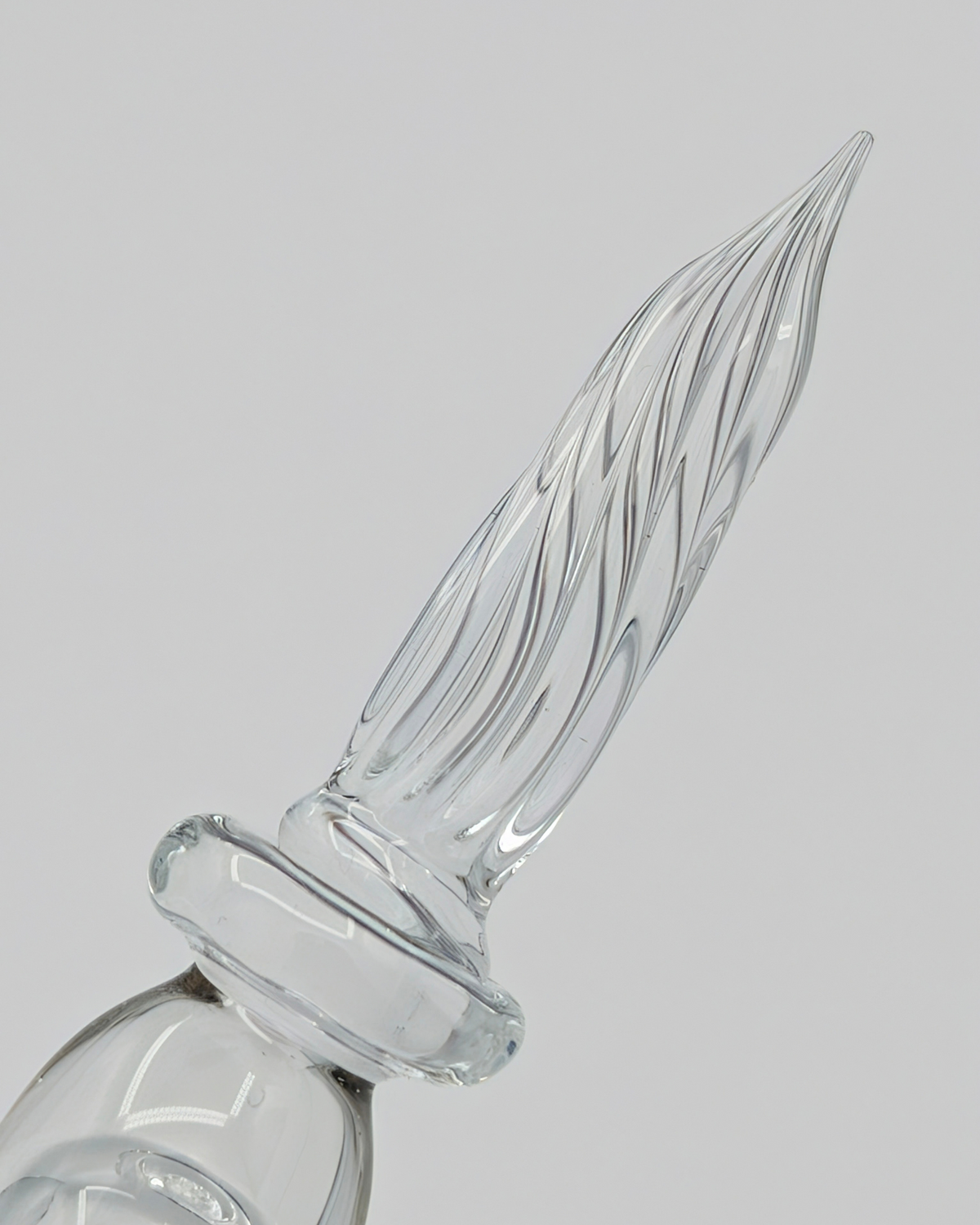
Every Storm Glass+ pen is shaped freehand over an oxygen torch by Kiyoshi Matsumura at Glass Studio Matsubokkuri in Suginami, Tokyo. The shaft is hollow rather than solid, keeping the pen light in hand, with a collar at the base of the nib to stop it rolling off the desk mid-sentence.
Specifications
- Total length: approx. 175mm
- Shaft diameter: approx. 12mm
- Weight: approx. 21g
- Contents (non-toxic): water, ethanol, natural camphor, ammonium chloride, potassium nitrate, natural tiger's eye
- Nib width: Fine (F), Medium (M), or Broad (B)
- Handmade in Japan
Using and Caring for a Storm Glass Pen
Dip the nib fully before writing — the spiral-cut grooves hold enough ink for several lines per dip. Tiger's eye sits at 6.5 to 7 on the Mohs hardness scale, durable enough that ordinary handling won't dull its band of light, though the chatoyancy is easiest to see under a direct lamp rather than flat overhead light. Rinse under lukewarm water after use and avoid sudden temperature swings, which stress the glass shaft.
Frequently Asked Questions
Why does the light band move when I turn the pen?
Tiger's eye contains fine parallel fibres left behind as quartz gradually replaced an earlier mineral. Light travels along those fibres and exits as a single band, which shifts position as the angle changes — a true optical effect, not a surface reflection.
Does the light band fade with handling?
No. The effect comes from the stone's internal fibre structure, not a coating or polish, so it won't wear off or dim with normal use.
Bilingual service — English and French.
Share